
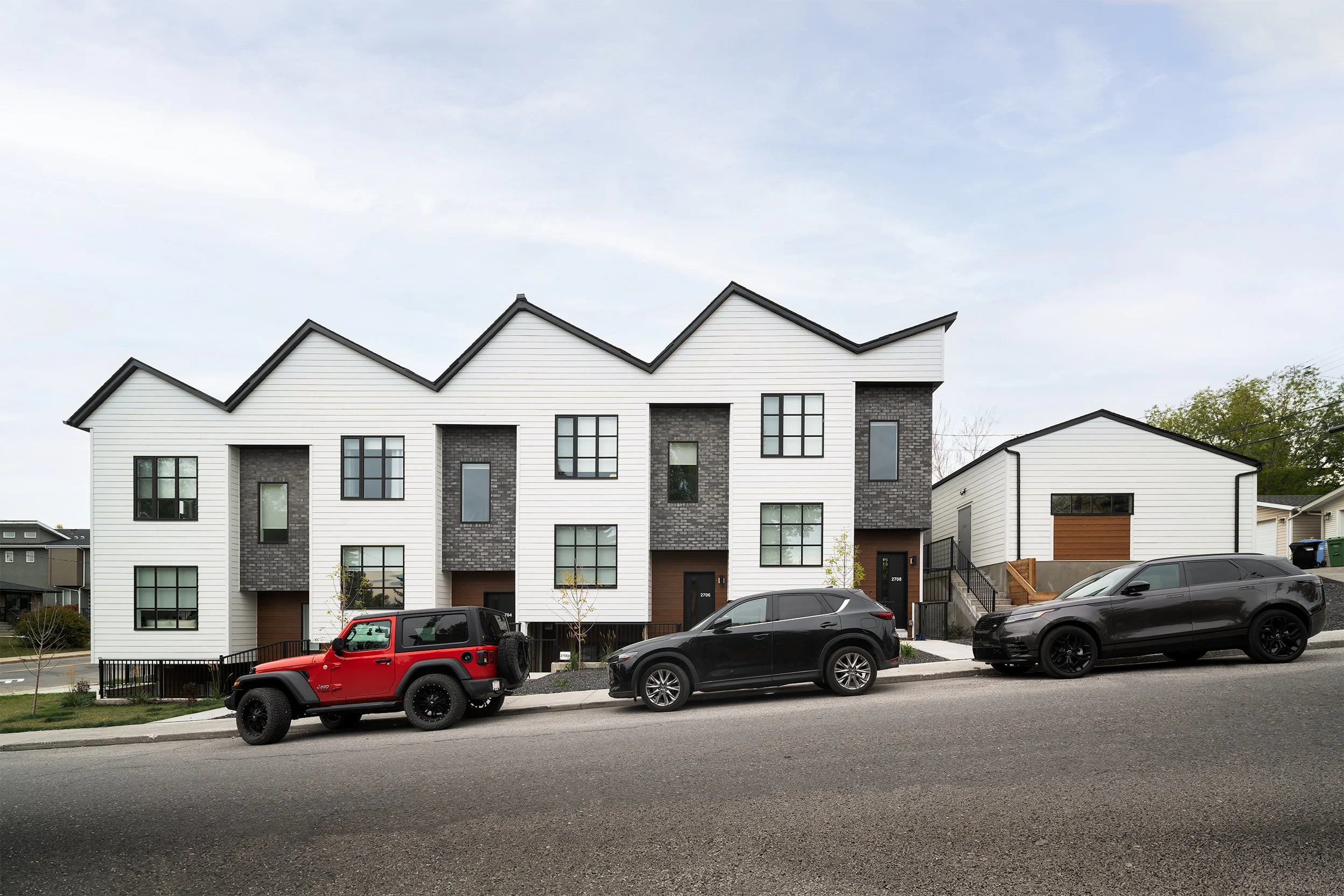
In August 2024, the City of Calgary applied blanket rezoning across residential neighbourhoods, reclassifying thousands of parcels from R-C2 to R-CG. It was a bold move—the kind cities rarely make. Now, a proposal before Council would reverse it. As a design studio that works across housing typologies and community planning, we think that would be a significant step backward.
Our opposition isn't rooted in abstract ideology. It's grounded in what we see on Calgary's streets, in our clients' project pipelines, and in the planning logic that underpins good cities. Here is our case.
Argument 01 — Property Rights Cannot Be Retroactively Stripped Without Justification
When the City designates a property R-CG by bylaw, landowners are entitled to rely on that designation. They make plans around it. They engage designers, run feasibility numbers, and in many cases begin the development process. The proposed repeal would extinguish that reliance without compensation and without evidence of specific harm arising from any individual parcel.
This is not how Calgary has historically treated property rights. A blanket reversal imposed on thousands of parcels simultaneously—without parcel-by-parcel review—sets a troubling precedent. It signals to property owners and the development community that land use designations are politically revocable on short cycles, which is precisely the kind of regulatory instability that suppresses long-term investment in housing supply.
Argument 02 — The Infrastructure Argument Has Already Been Refuted
The most common justification for repeal is that blanket rezoning places undue pressure on ageing infrastructure: sewer laterals, water mains, the electrical grid. It sounds reasonable. It also happens to be contradicted by the City's own analysis.
In December 2025, City Administration presented a report examining nearly 2,000 homes approved under blanket rezoning. The finding: fewer than one percent of those projects required any upgrades to public utilities. Administration characterized the infrastructure impact as minimal. Council should not dismantle a significant housing policy on the basis of a concern that its own technical staff have already assessed and set aside.
Argument 03 — Repeal Makes Calgary's Housing Crisis Worse
Calgary is short on housing. The evidence is everywhere: rising rents, low vacancy rates, and a population that has grown faster than its housing stock. Blanket rezoning was one of the few tools the City deployed that directly addresses supply at the neighbourhood scale—by permitting rowhouses, stacked townhomes, and grade-oriented infill on lots that previously could accommodate only a single detached home.
Between 2014 and 2023, the Land Use Redesignation process approved 94% of applications—but only after an average wait of four to six months and the payment of significant fees. That process added cost and delay to projects without meaningfully filtering outcomes. Reinstating it will not improve housing quality, preserve neighbourhood character, or protect infrastructure. It will deter small-scale builders, increase carrying costs, and reduce the pipeline of modest, family-sized infill housing that Calgary's workforce needs.
Argument 04 — $129 Million in Federal Funding Hangs in the Balance
Calgary entered into a $251.3 million Housing Accelerator Fund agreement with the federal government. A significant portion of that funding—roughly $129 million—has not yet been disbursed. The Canada Mortgage and Housing Corporation has stated publicly that it expects Calgary to honour its commitments to eliminate exclusionary zoning. Calgary taxpayers cannot afford to gamble $129 million on informal assurances that federal officials will take a flexible approach. The prudent course is to preserve the zoning framework that underpinned the agreement.
Argument 05 — The Uptake Has Been Modest, Which Means Targeted Fixes Are Possible
Data presented at the December 2025 Council meeting showed that in the seven wards whose councillors voted for repeal, only 16 of 478 total applications were made under R-CG zoning. Blanket rezoning has produced far less disruption than its opponents claimed. This is actually good news: it means that legitimate concerns about specific outcomes—mid-block massing, contextual setbacks, lot coverage—can be addressed through targeted amendments to the Land Use Bylaw, not by stripping the R-CG designation from thousands of properties.
Several Council members proposed exactly such amendments during the December debate. Those alternatives deserve serious consideration. They offer a path to addressing real design concerns while preserving the housing supply gains that blanket rezoning has made possible.
Argument 06 — Policy Stability Is a Precondition for Good Design
As designers, we plan in time horizons that span years. A rowhouse project from initial concept to occupancy permit typically takes 18 to 36 months. Site assembly, feasibility studies, design development, permit applications—all of it presumes that the regulatory environment will remain stable long enough for a project to proceed. When land use designations become politically reversible on a two-year cycle, good projects don't get built. Risk-averse capital goes elsewhere. The city that results is not more liveable—it is more expensive, less diverse in housing form, and less responsive to the needs of the people who actually live in it.
Rezoning for Housing was the product of a democratic process: Calgary's longest-ever public hearing, with nearly 1,000 participants, followed by a Council vote. Reversing it within less than two years, before its long-term effects can be measured, does not serve Calgary's residents. It serves a political narrative at the expense of a functional housing system.